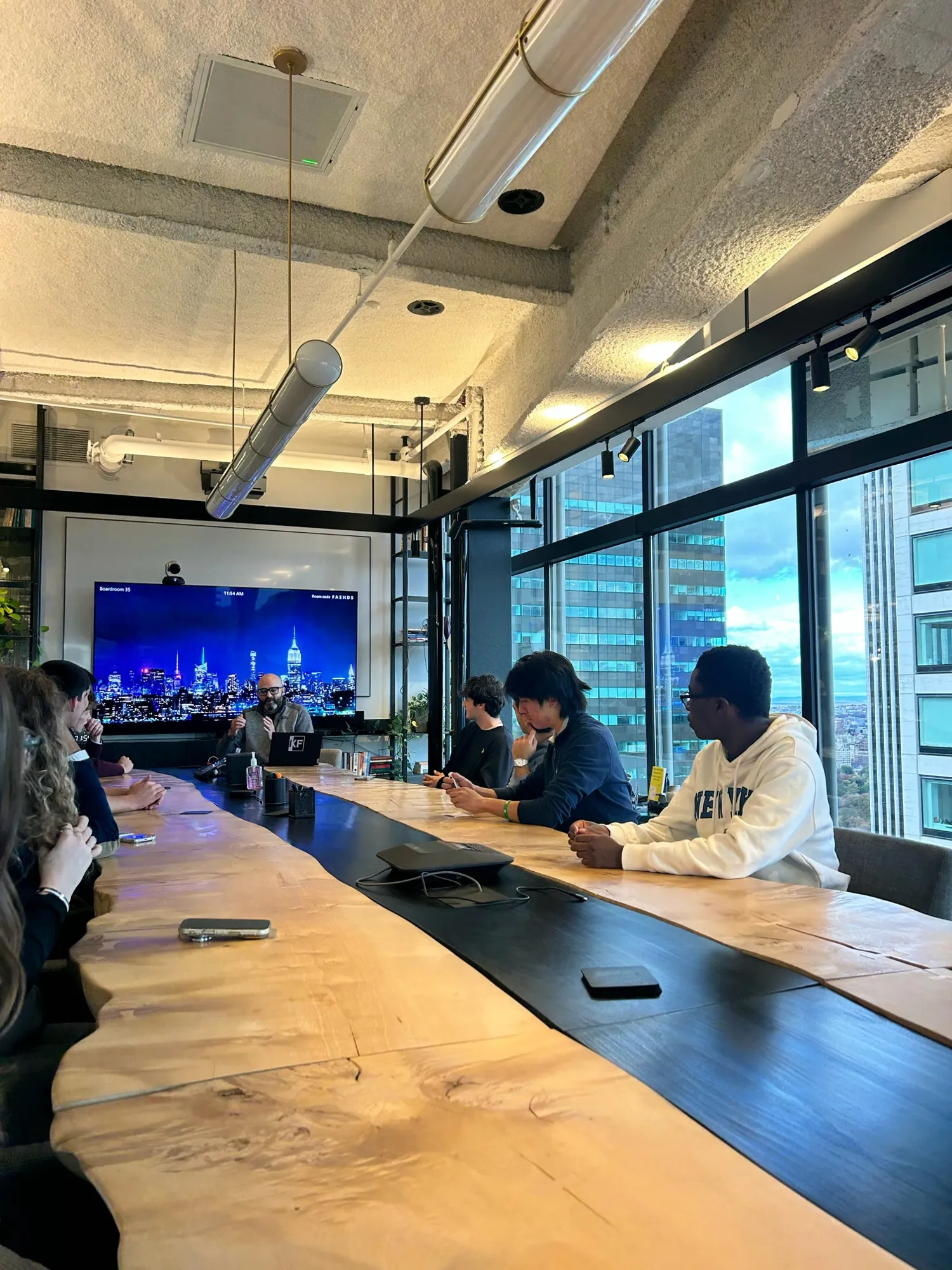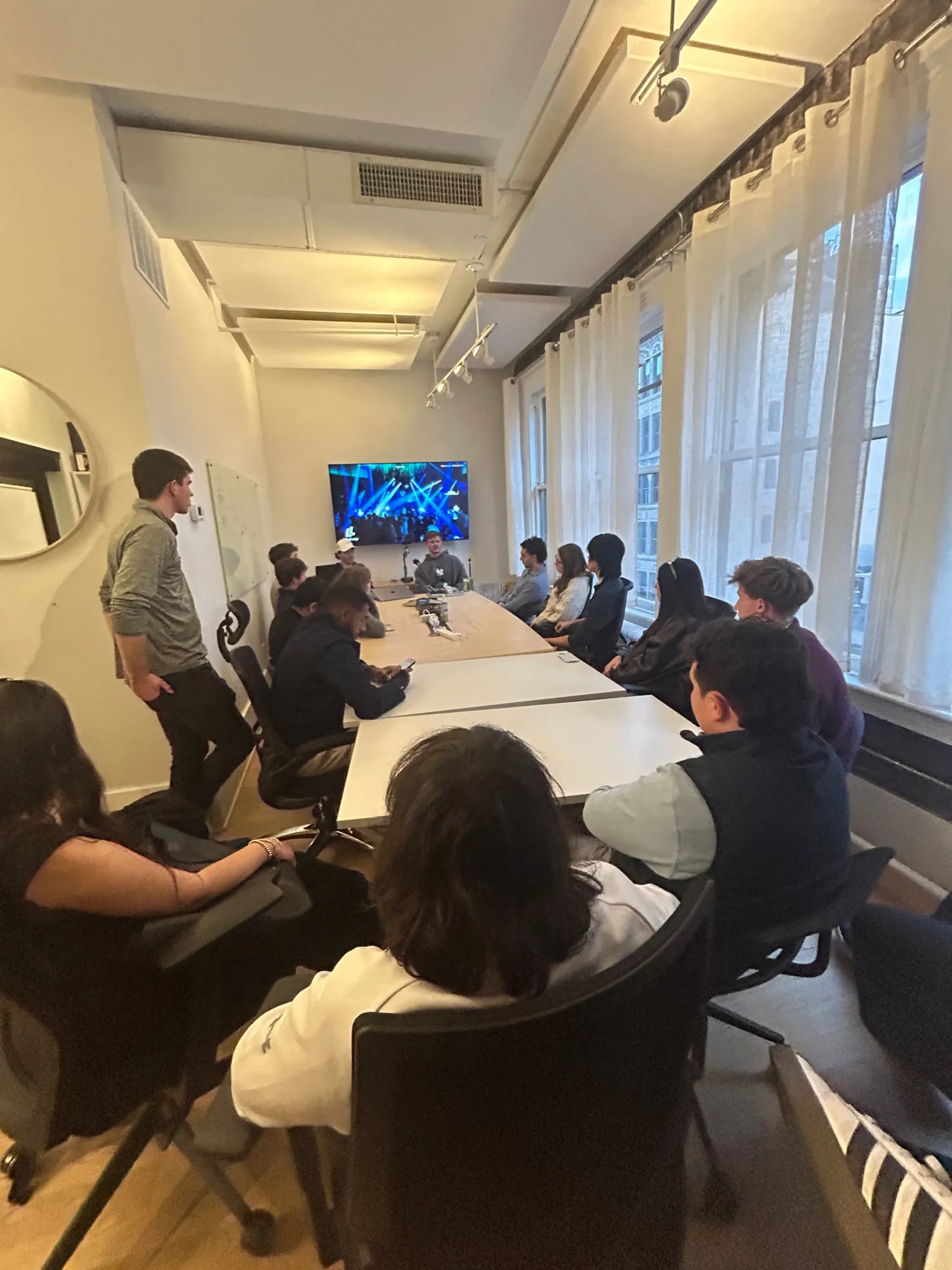
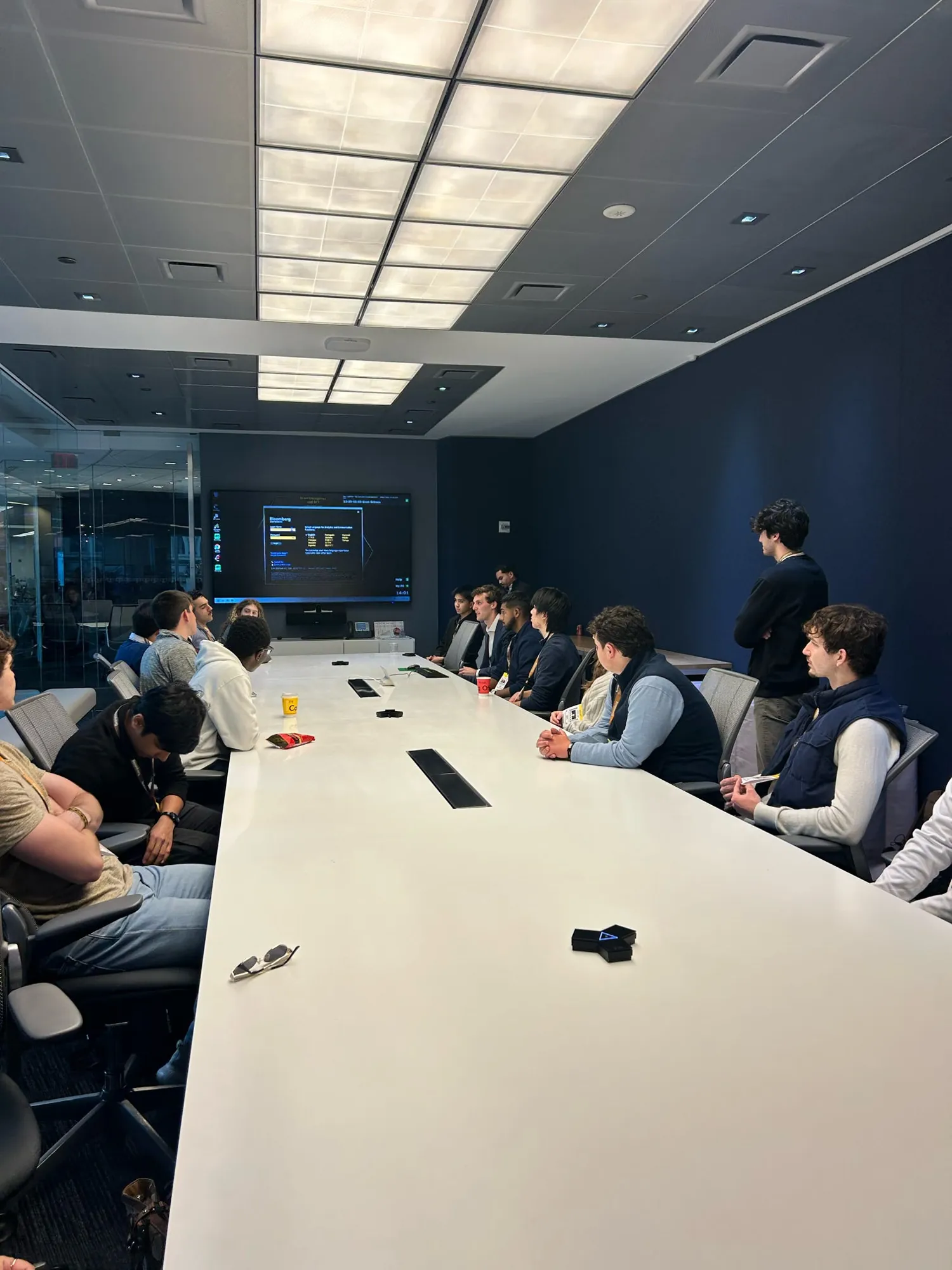
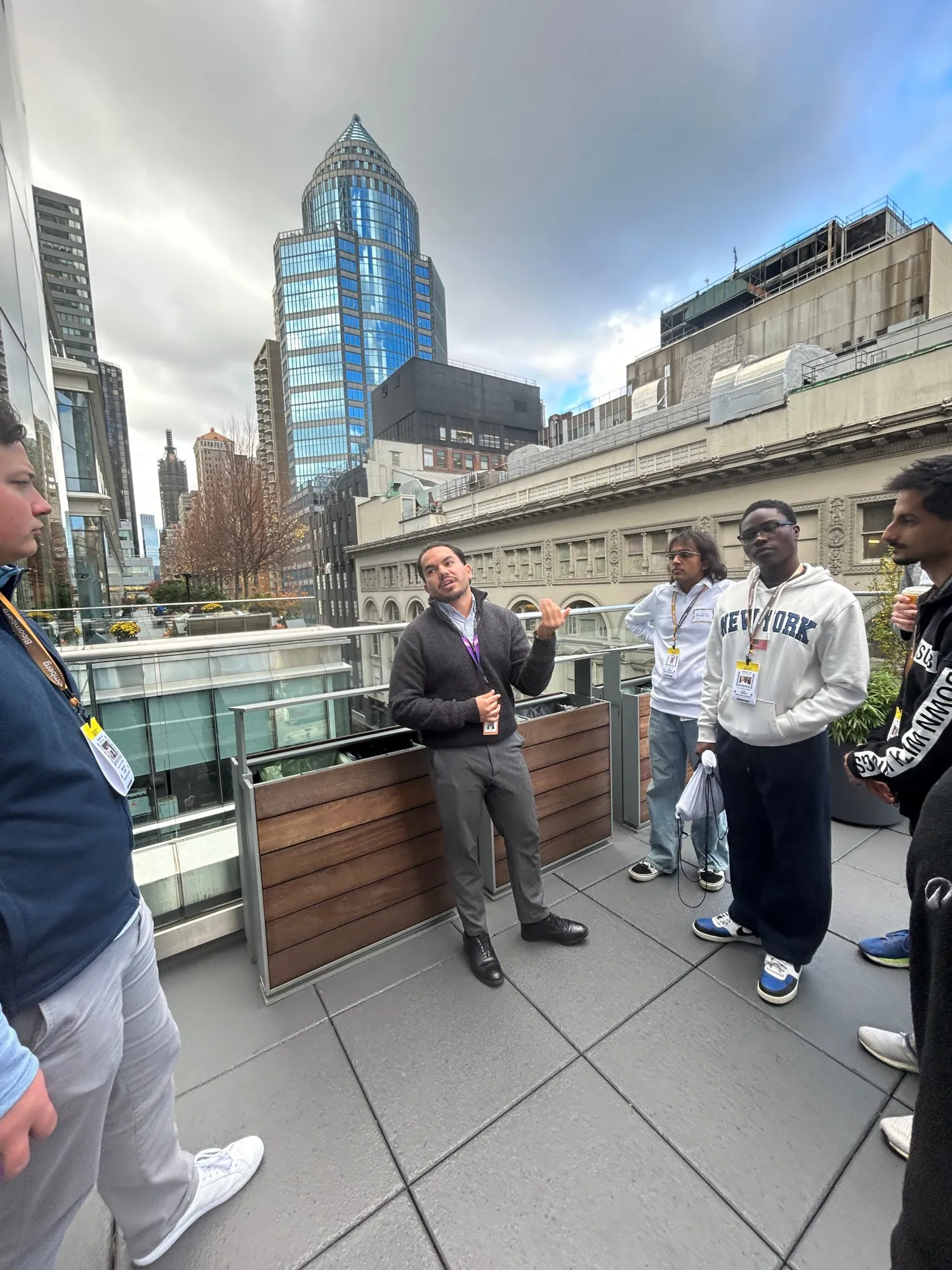
Chris showed up slightly out of breath. He had run up from downstairs to meet us. Evan, a Penn State alum, split the group in two, and both halves set off through Bloomberg’s global headquarters for a tour before we sat down with the Terminal itself.
With Evan Grimes, Bloomberg sales and a Penn State alum, and Chris, Bloomberg analytics (equities and derivatives)
It was the most “New York” of our three stops. It was also, surprisingly, the most useful for anyone going back to campus, because almost everything they showed us is available on Penn State’s terminals for free.
Food, fish and fauna.
About 6,000 people work in the building, and more than 10,000 pass through every day once you count clients and visitors from other offices. The floor we started on is called the Link. To get anywhere else in the building, you have to pass through it. You change elevators there, and you can’t ride the elevator back down. You take the stairs. It is all designed to make people bump into each other.
Chris summed up the office philosophy in three words: food, fish and fauna. There are snack stations on every floor. There are fish tanks everywhere, apparently because Mike Bloomberg once read that fish have real personalities, and they get serviced twice a week. And there are plants all over, to keep the place feeling human.
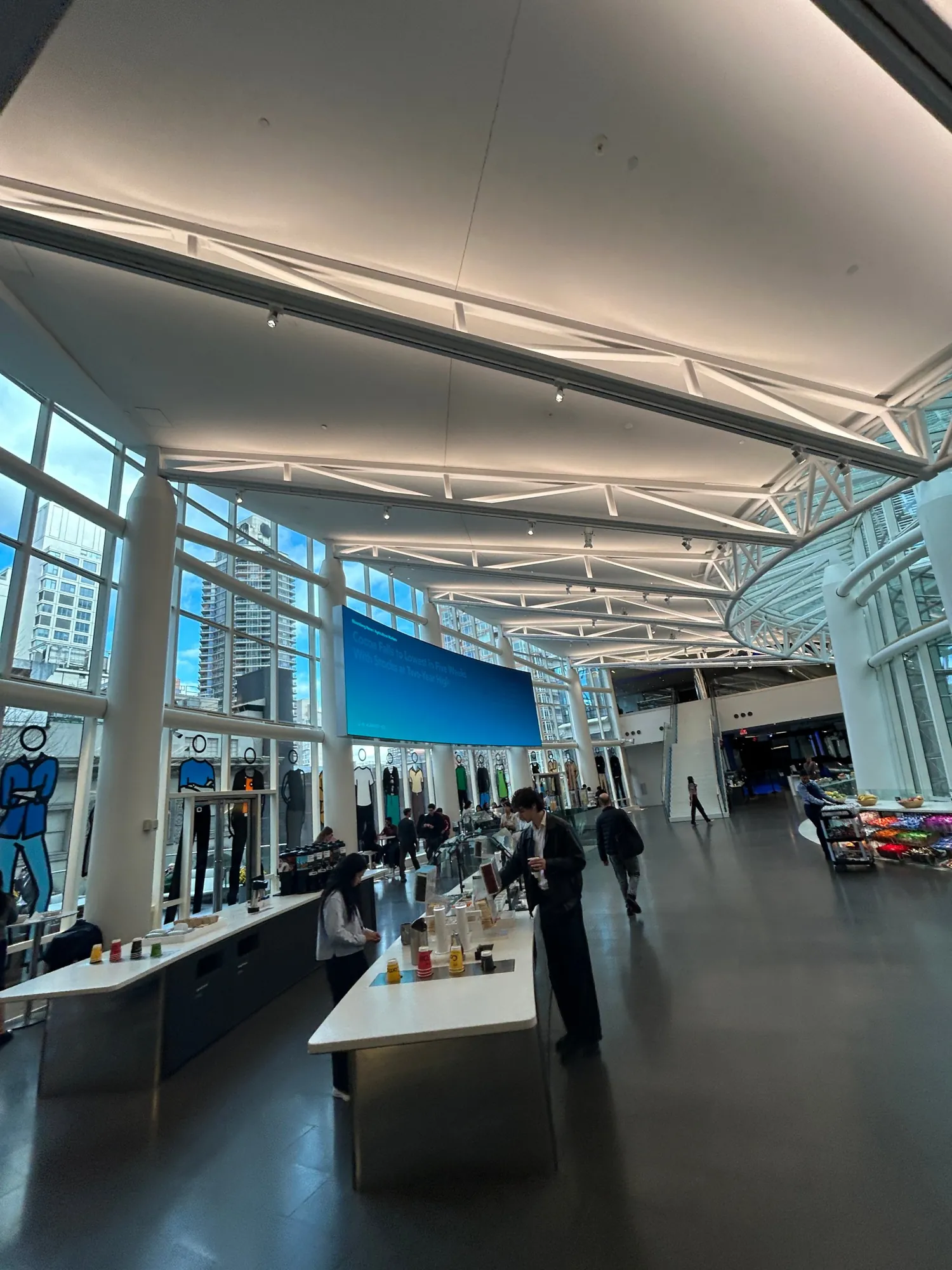
We stepped out onto a terrace that wraps the building, walked past the live news set (the people you see walking behind the anchors on Bloomberg TV are real employees on their way to work), and heard about the steady stream of visitors, from pro athletes to heads of state stopping by during UN week. Evan and Chris also mentioned that Mike Bloomberg still comes into the office often.
It started with a tray of coffee.
Long before the tower, Mike Bloomberg was building a product for people in the fixed income markets, and he needed to know how they actually worked. So early in the morning he would stop at the deli across from Merrill Lynch, buy coffee and tea with every combination of milk, and walk the trading floors handing them out.
The drinks were a way to start conversations. Once someone had a coffee in hand, he could ask what their day looked like, what slowed them down and what they thought of the product. He kept coming back, building relationships and gathering feedback, and kept building around the problems traders described. Information in bond markets was scattered and slow, so the product brought it together in one place.
It worked. Merrill Lynch became Bloomberg’s first major customer, with an order for 20 terminals. From there, Bloomberg grew to well over 300,000 paying customers around the world, and eventually bought its headquarters building floor by floor as space opened up.
That habit never really left. Our hosts described a company that is still built around getting close to clients: understanding their workflows, listening to what is broken and building to fix it.
Before you build anything, go sit with the people who’ll use it and ask what their day is like.
Our takeaway from the Bloomberg origin story
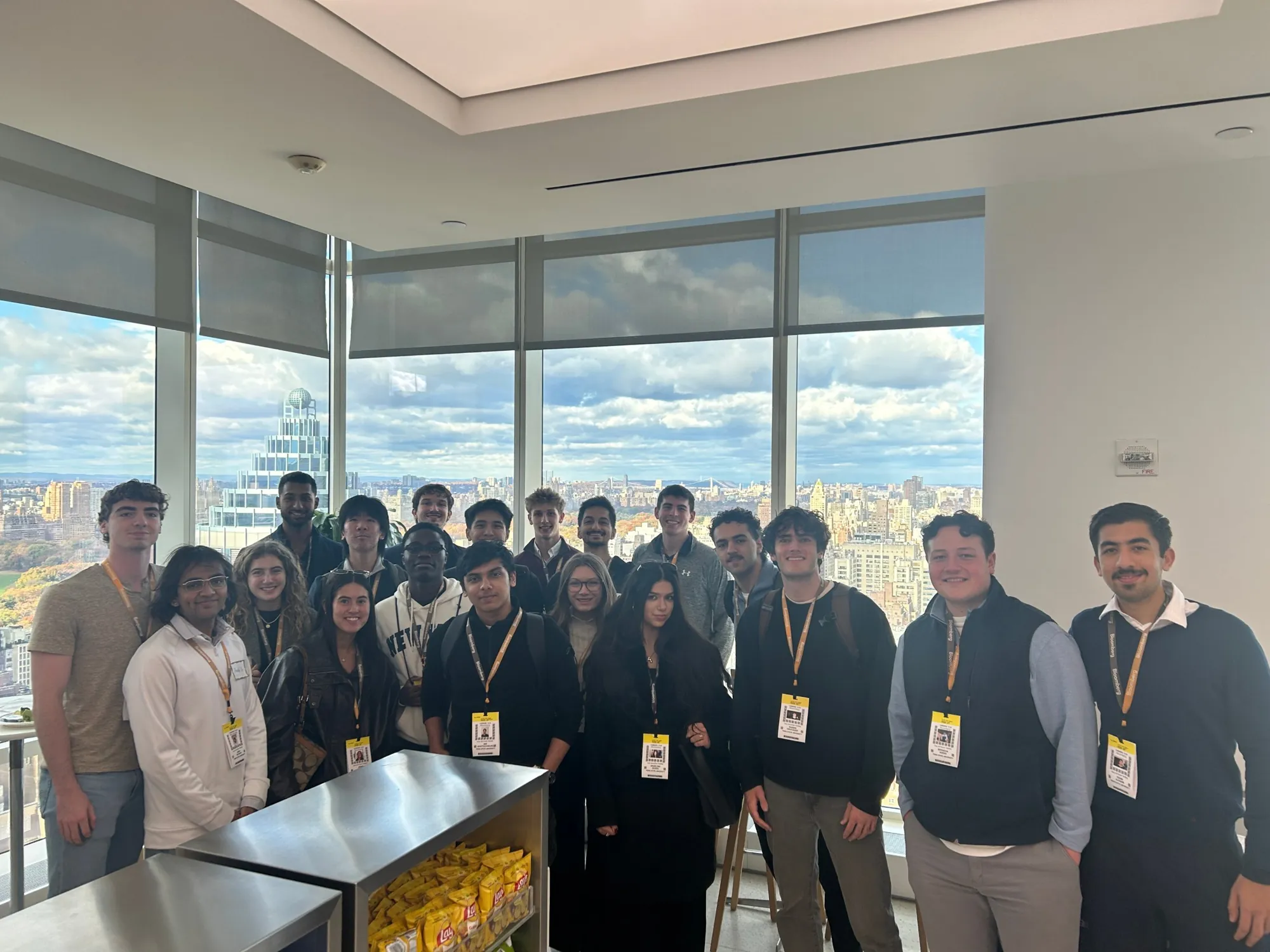
Two very different ways in.
Evan manages Bloomberg client relationships across Pennsylvania, New York and New Jersey, helping clients get the most out of the Terminal.
Chris’s path was less direct. He was doing foreign exchange sales at a company that used to be Western Union’s corporate arm. He had a background in small business accounting and wanted more experience. A friend at Bloomberg told him to apply for customer support and work his way up. He spent about a year and a half on the support desk and has now been in analytics for about three years. Bloomberg Philanthropies also backs FIRST Robotics, the program Chris was on in high school, so he calls it a full-circle moment.
One pattern stood out: people stay. Chris’s department head has been there about 25 years.
What makes the Terminal different.
Someone asked the obvious question. Why can’t this just live on a MacBook? The data is part of the answer. Decades of history, estimates and revisions for thousands of companies, across every asset class worldwide, isn’t something you store on a laptop.
But the bigger answer is what all of it adds up to. Plenty of tools do one of these things. The Terminal brings them together in one integrated platform, so a user can go from a headline to the numbers to a conversation with a counterparty to a trade without leaving it. Evan breaks it down as DANCERS:
DANCERS
How our hosts break down the Terminal. As explained in the room.
- DataFinancial statements, fundamentals and market data across global asset classes.
- AnalyticsCharts, dashboards and tables built on that data.
- NewsMore than a thousand news wires aggregated, with AI summaries layered on top.
- CommunicationsInstant Bloomberg chat. A vast majority of financial market transactions happen over it.
- ExecutionTrading platforms built right into the Terminal.
- ResearchCommentary from brokers like JPMorgan and UBS, all in one place.
- SupportA 24/7 help desk that follows the sun from New York to London to Tokyo. Nobody comes to help you on a free site.
Your Bloomberg starter kit.
This is the part to bookmark. Everything below works on the shared terminals in Smeal. Our hosts suggested checking with the lab administrators for the best times to go.
Nine functions to start with
Type the code into the command line and hit enter. Bloomberg has more than 30,000 functions. Our hosts said anyone who claims to know them all is lying.
- Create your login firstDouble-click the green terminal icon on the home screen and choose “create new login.”
- BCER: free certificatesSign up through the terminal, not the website, where you’d be charged. Start with Finance Fundamentals and Market Concepts. Then take Spreadsheet Analysis, which covers Excel, the Bloomberg API and BQL, Bloomberg’s SQL-like query language.
- BPS: home baseThe Bloomberg Professional Services resource center. If you log in and don’t know where to go, start here.
- FA: fundamental analysisIncome statement, balance sheet and cash flow, with a link back to the source document for every number.
- HELP + any functionType HELP FA (or any function) for a full guide, methodology and FAQs. Training videos are there too.
- FLDS: data field finderEvery metric maps to a field you can pull into Excel or Python. It also explains how each metric is calculated.
- MODL + DS: company models and documentsWhat drives a business, plus AI-generated bullish and bearish takeaways with sources. DS lets you search source documents and ask questions of them. Great for stock pitches.
- PEOP: the directoryAbout 4.7 million profiles, including more than 8,300 Penn Staters. Filter by company, role or place. Use it for career research: see where people work, what paths they took and how wide the Bloomberg network reaches.
- JOBS and AIBBJOBS shows roles posted directly by Bloomberg users, beyond LinkedIn. AIBB tracks every AI feature being added to the Terminal.
Ask B, and the real lesson.
The showstopper was Ask B, Bloomberg’s conversational AI. Chris typed a plain-English request for a stacked bar chart of quarterly capex for Meta, Google and a few others over three years. It built the chart along with a formula you can paste straight into Excel. Our hosts called it one of the fastest-adopted features in Bloomberg’s history. It’s only on individual Bloomberg Anywhere licenses, though, not the shared campus terminals.
Then came the line that stuck with us. Evan doesn’t think AI will take your job, but someone who is dangerous with AI might. People don’t get paid for knowing more Bloomberg commands. They get paid for knowing what to do with the answer. And when you only have ten seconds in front of a trader, the skill that matters is framing what is important in as few words as possible.
AI won’t take your job. Someone who’s dangerous with AI might.
Our takeaway from Evan Grimes
They asked what we’re building.
Before the demo, Evan went around the room and asked NES members to share what they’re working on. The answers included a custom 3D printing business for hobbyists, a texting-based AI health assistant that tracks diet and workouts, and a landscaping company now building AI to automate its own payroll and client communication. Evan said Bloomberg usually works with business and economics students and wants to reach further across Penn State. This was a good start.
On the way out, we met someone who runs Bloomberg’s agriculture coverage: screwworm, cattle, beef and wheat prices, USDA reports. He said he knew nothing about agriculture before taking the job. Now it is one of the most connected things he works on.
A few more things we asked.
Answers are condensed and paraphrased from the conversation.
Is there an API so we can use our own models?
Yes. FLDS lists every field available through the API, and the Spreadsheet Analysis certificate walks through using it. Fields can refresh live. A fiscal-period-offset setting, for example, rolls automatically to the latest completed quarter.
How long did it take you to learn all this?
They’re still learning. With 30,000+ functions, clients teach them new tricks all the time, and they called that the best part of the job.
If AI can pull anything, do people still need to know the functions?
It doesn’t matter whether you know every function. It matters whether you make an impact. Use AI to free up time, then spend that time on the things only you can do.
What’s your best professional advice?
Reputation. It takes a lifetime to build and one day to lose. Lead with honesty and integrity, treat people fairly, collaborate, and show up with a good attitude. Evan said they sound like playground rules, and they still apply after you graduate.
What we took home.
Bloomberg began with a tray of coffee and a lot of questions on a Merrill Lynch trading floor. Decades later, the company’s edge is still the same idea at enormous scale: get closer to what users need than anyone else. For students, the practical takeaway is even simpler. The Terminal sits in Smeal, the certificates are free, and the Penn State network on it runs 8,300 people deep.
Three things to try.
- Book an hour on a Smeal terminal and finish the first BCER module.
- Run MODL on a company you care about and read the bull and bear case.
- Look up a few Penn Staters on PEOP in a field you’re curious about, and map the paths that got them there.