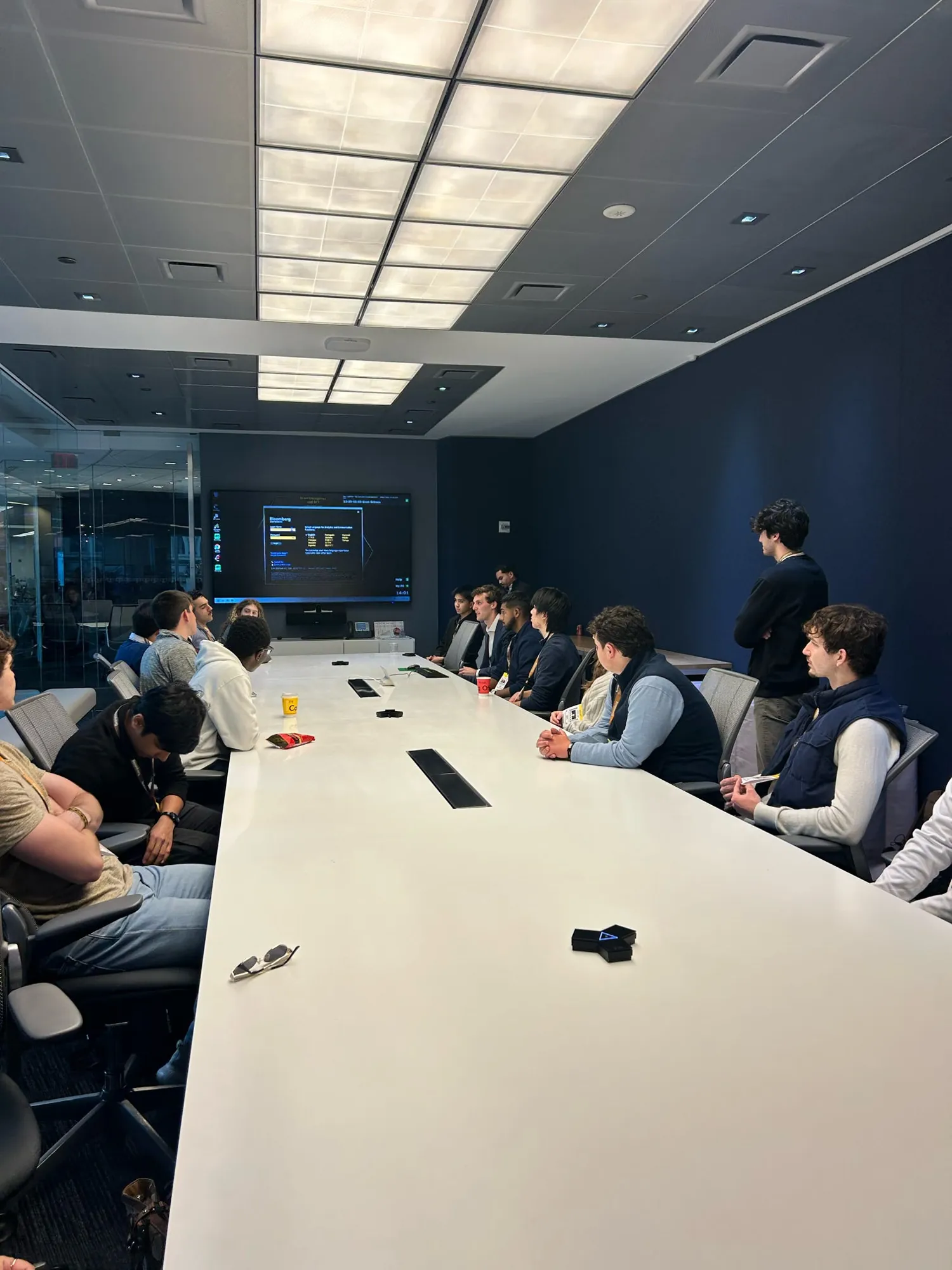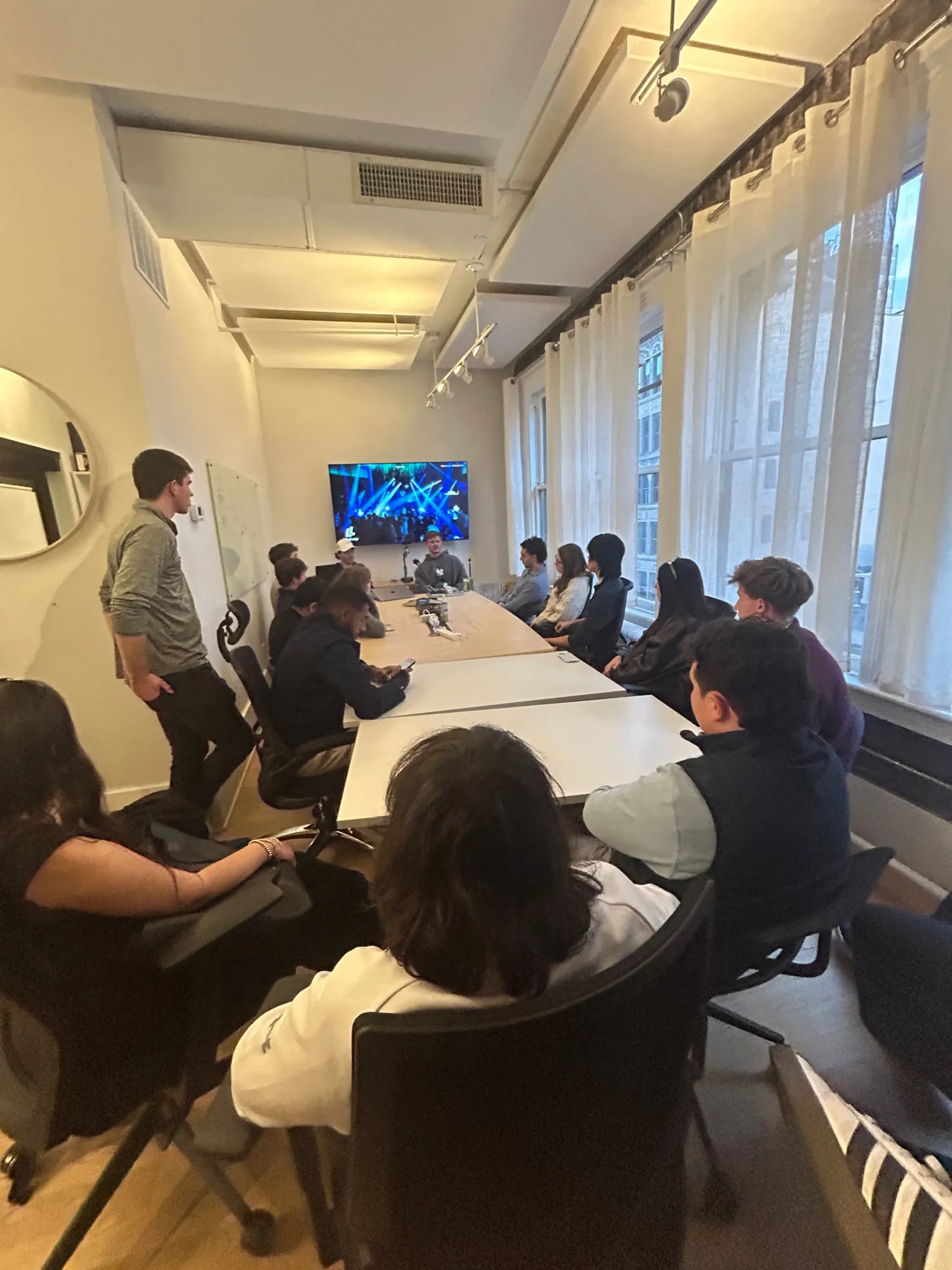

Ben Birnbaum opened with a Penn State story. His younger half brother had picked Ohio State, and had FaceTimed him from the stands while the Buckeyes chanted something unkind about us. Then he asked the room what year everyone was, whether anyone had started a business, and promised to be an open book for the next forty-five minutes. He was.
With Benjamin Birnbaum, Partner at Keyframe Capital and co-founder of Terawatt · Penn State ’12
Ben now runs an investment firm from a two-story office in Midtown, but the part of his story that landed hardest with a room of students was how long and unglamorous the road was before any of it worked.
Learn the language of business. Then leave.
Ben grew up in Cherry Hill, New Jersey, and finished Penn State’s Master of Accounting program in 2012. He had always wanted to start a business. A Smeal seminar told him accounting was the language of business, so he figured he should learn it. Then he interned at PwC and realized very quickly that it was not for him.
He used his position as a student to network his way into McGraw Hill Education just as textbook companies were scrambling to become software companies. He ended up working directly for the CEO while the business shrank from about 7,000 people to 4,000 and built a 1,000-person technology and innovation group. He called himself a fly on the wall. He also called it the best education he could have asked for.
His reasoning is worth stealing. Put yourself wherever things are changing fastest. When the future looks different from the past, the people with twenty more years of experience don’t actually know more than you about what comes next. That is your opening.
The bird’s-eye seat.
Looking for that same kind of disruption in a different industry, Ben joined MV Transportation, the company that operates public transit in about 240 cities across the US and Canada. Most people have never heard of it. Look at the side of a city bus, though, and you might see its name.
He arrived just as Uber was exploding. Uber pulled in an incredible amount of talent, and when those people left, they started electric car companies, autonomous vehicle companies and dozens of scooter-share startups. Ben had a front-row seat to all of it.
His insight was simple. Consumers adopt new technology slowly because everyone decides for themselves. Fleets switch the moment the numbers work. Once an electric bus is cheaper per mile, a fleet operator converts. And electric fleets use an enormous amount of power, in places where transportation actually happens. That is a much harder real estate problem than a data center, which can go almost anywhere. Ben was clear that the business was simple, and he thinks that helped.

Buy the land. Wait for the market.
In 2017, Ben and two co-founders drew the idea on a whiteboard. They called it a “universal mobility hub” at first, imagining drones and everything else. The company launched as Pearl Street, named after the first commercial power plant in the United States, in lower Manhattan.
There were barely any electric fleets yet, so there was nobody to sell to. Instead they raised $100 million to quietly assemble real estate with access to serious amounts of power, a rare thing inside a city. The pitch to investors was honest: if electric vehicles don’t happen, we sell the real estate. We’ll have wasted our time, not your money.
For two and a half years they built the portfolio, went to conferences and waited. Around 2020, customers finally started showing up. A conversation with Amazon about its trucking fleet made one gap obvious: they hadn’t yet hired anyone who could engineer what Amazon was asking for. That led to the most important hire in the company’s history.
Then came a stroke of luck. Autonomous cars are almost all built on electric platforms, and they need to charge somewhere. Waymo needs roughly 500 charging hubs in the US by 2030 and around 8,000 by 2040. In 2024, Terawatt had two running for them. As Ben put it, that left 498 to go. The business grew five times over in 2025, and five times again in 2026. Today the limit isn’t demand. It is how fast the team can find, permit and build the right sites.
Terawatt now has around 100 people in San Francisco, led by that same hire as CEO. Ben and a colleague stayed on the board and kept raising the capital behind the build-out. The investors behind Terawatt then backed Ben’s team to do it again, and that became Keyframe Capital: a team of about twelve that has invested in roughly thirty companies across power, transportation and digital infrastructure like data centers.
Good ideas come from bad ideas.
Asked how he found his co-founders, Ben said it was long and a little random. He and Ethan, then roughly the fortieth employee at Rivian, spent about nine months brainstorming and sharing ideas with smart people who would tell them why they were wrong. Someone introduced them to John, who had just sold Virgin America and was looking for his next thing. They pitched him one of their bad ideas.
That was May or June of 2017. The three of them whiteboarded in July and started working in earnest that fall. Along the way Ben met plenty of people who didn’t work out. He thinks that is normal. Share your thinking openly and let your network point you toward the right people.
Two a.m., on a sidewalk, in winter.
The hire was Google’s head of energy, who had spent a decade taking Google from a handful of data centers to the largest corporate buyer of power in the world. Ben was 29.
He met a couple dozen candidates. She was the third serious one. It was during Covid, so he was flying around and brainstorming in people’s backyards. When she came to New York, the two of them sat on a sidewalk until 2 a.m. in the freezing cold, drinking martinis and getting to know each other.
How did he convince her? Honestly, he said, by believing it. He told her the country only had to build the interstate highway system once, and this would be the next great build-out. She believed it because he so clearly did.
People will believe in what you’re building when they can see that you do.
Our takeaway from Ben Birnbaum
Money follows good businesses.
This was the section people took the most notes on. Ben’s view is that money doesn’t create good businesses. It follows them. So don’t walk around saying you need money to start. Know what needs to happen, start executing as if it will all come together, and then go make it come together.
His advice was to go to investors with a plan, not an ask. Show them what you’re doing and ask for feedback. Investors want to follow someone who is already executing. If you’re asking for money, they feel powerful. If you’re not, they start to wonder what you know. Trust matters as much as the plan, because plans always change, and trust is built over months, not in a single pitch.
How to meet investors
Paraphrased from the Q&A. Guideposts, not rules.
- Start inside your industry.Most industries have firms that focus on them, and former executives who invest as angels. Find out who backs businesses like yours.
- Get warm introductions when you can.Ask existing contacts for one or two people you should meet. You don’t need many before the right doors start opening.
- Hustle when you can’t.He’ll go to a conference just to bump into someone, or email a person in another city to say he’ll be there Tuesday, and then book the trip if they reply.
- Track every relationship.He keeps a detailed record in Airtable: what kind of investor each person is, typical check size, and what stage they back.
- Ask for feedback, not money.Bring the plan. Ask what they’d change. Let the relationship turn into an investment.
A reason to be a maniac.
Now that he is on the other side of the table, the bar to get in the door starts with integrity. If a number doesn’t match and the explanation is fishy, he walks away every time. After that comes real command of the business.
But the thing that makes a great founder, he said, is having a reason to be maniacal about succeeding. That reason can come from anywhere, including financial pressure. Every plan goes wrong. You have to be able to take the punches, learn from each one, adjust and keep going, and you have to be curious enough to enjoy that process.
A few more things we asked Ben.
Answers are condensed and paraphrased from the conversation.
Does running a company make you a better investor?
Yes, in two ways. You understand what actually happens inside a business, from managing culture to designing a sales incentive plan. And founders give you instant credibility because you know what their side of the table feels like.
How do you decide what to hand off?
He starts out a little overbearing and waits for people to push back and say they’ve got it. He looks for people who will color outside the lines. When someone doesn’t work out after being given room, knowing when to replace them, and having the fortitude to do it, matters just as much as the hire.
Should we work at a big company first?
For him it was essential. A paycheck and a head-of-strategy role gave him patience and access to people at Ford, GM and Microsoft. A big company teaches you management and professionalism, but not much about running a business. His point for students: you have that patience right now, while you’re in school.
How is Keyframe using AI?
Claude, ChatGPT, and tools like Granola and Fellow. The biggest win so far is using Claude to cut down how much they rely on lawyers for contracts. They are working toward automating whole processes, but haven’t nailed it yet.
What does a normal day look like?
He sits on six or seven boards and raises capital for the firm. About 75% of his time is scheduled with portfolio companies, investors and founders pitching him. He protects the other 25% for research and finding the next big idea.
What would you do differently in college?
Start more things, sooner. He once tried a “rate my internship” site that didn’t take off but taught him how to start a business. He’d try a business a month: vibe-code a service and land one customer, or try selling a competing product on Amazon. Getting through the basics, like setting up an entity and taking payments, compounds over a career.
What we took home.
Ben spent two and a half years building something before anyone wanted it. He recruited his most important hire on a freezing sidewalk at 2 a.m. He raises money by not asking for it. Under all of it is the same habit: decide what has to happen, then go make it happen before anyone hands you permission.
He finished by offering to answer questions over email and make introductions for anyone in the room. We plan to take him up on it.
Three questions worth asking.
- Where is your industry changing so fast that experience doesn’t count for much yet?
- Who could you show your plan to this month, asking for feedback instead of money?
- What is your reason to be a maniac about this?