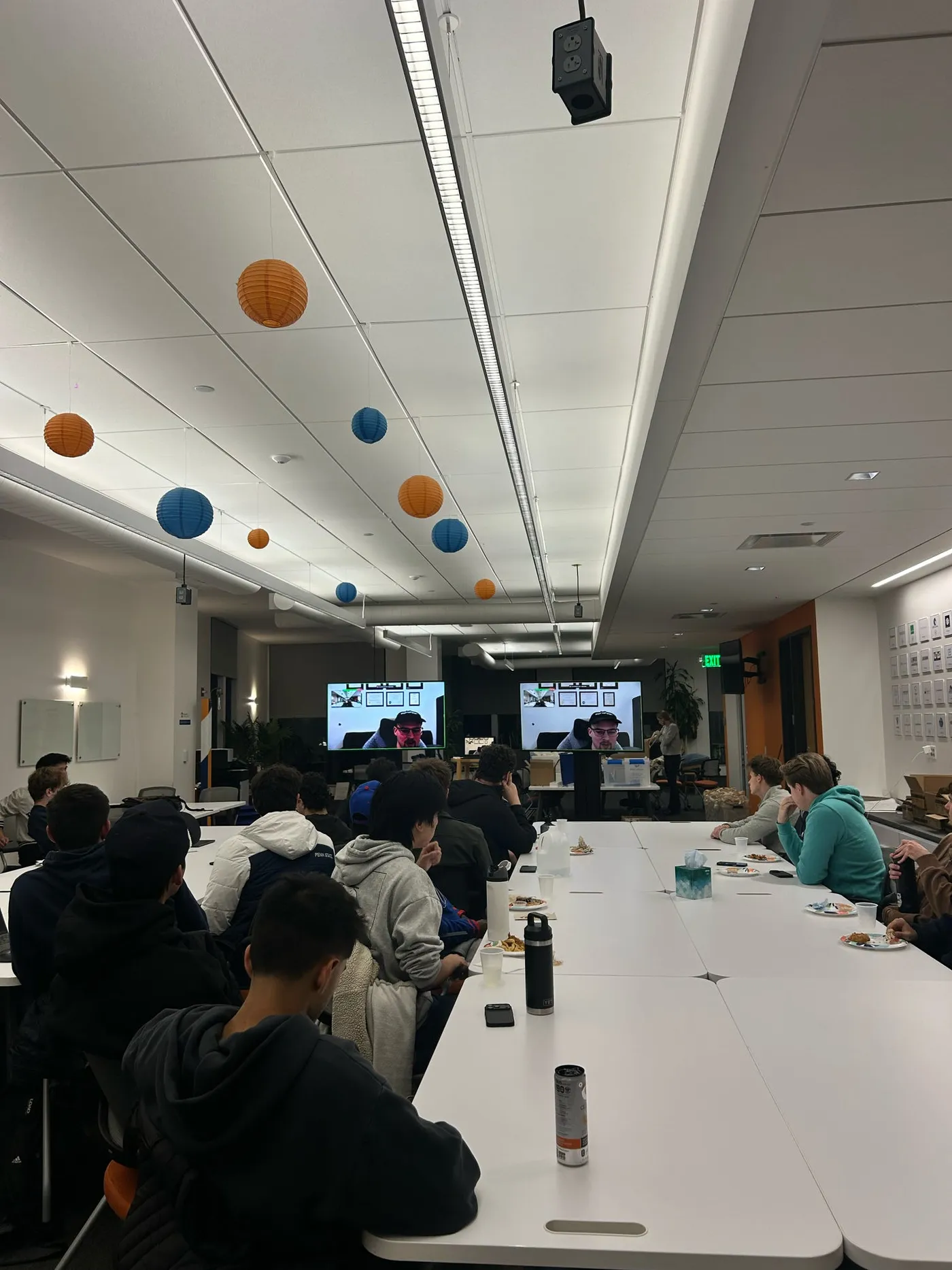
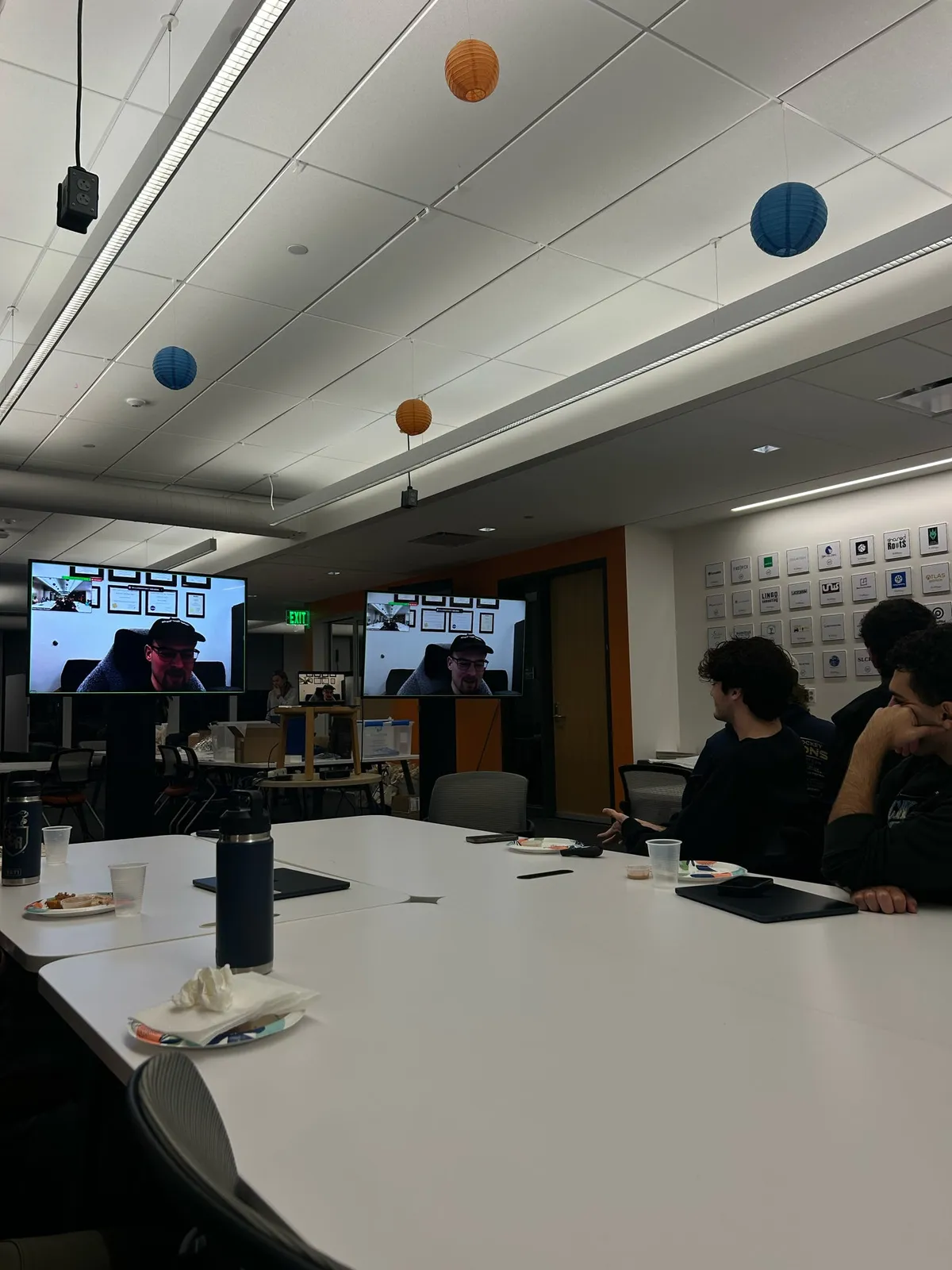
Jason Cornelius joined us by video from Buda, Texas, just outside Austin, sitting in front of a wall of framed NASA certificates. A year and a half ago he was designing a nuclear-powered helicopter bound for one of Saturn’s moons. Now he runs Perseus Defense, a nine-person startup that builds small, low-cost missiles designed to knock drones out of the sky. He closed out our fall speaker series by telling us how he got from one to the other, and how much of it he had to learn from scratch.
Jason did his bachelor’s, master’s and PhD in aerospace engineering at Penn State. His co-founder and CTO, Steve Messinger, did his undergrad and master’s here too; the two studied aerospace together before Steve went on to build autonomy systems at Boeing. So this was a homecoming of sorts, even through a screen.
From a helicopter for Titan to a startup.
As a student at Penn State, Jason worked on the rotors for Dragonfly, a car-sized, nuclear-powered helicopter that NASA plans to launch in 2028 and fly around Titan, Saturn’s largest moon, for two years. Penn State played a big role in building it. He kept working on it after joining NASA in 2018, and he also taught at Stanford.
He was not looking to start a company. About two years ago, Steve told him he wanted to. They looked around aerospace and defense for a problem worth solving, and with the war in Ukraine, one stood out: cheap attack drones, and almost nothing cheap enough to stop them. They figured a big contractor like Raytheon, Lockheed or Boeing would build a low-cost interceptor soon. Jason went back to NASA. Steve went back to his job. Over the next few months, they convinced themselves nobody else was going to do it. So they quit.
1,000 against 100,000.
The pitch comes down to one comparison. By Jason’s count, the United States makes about 1,000 interceptor missiles a month. Russia, Iran and China each make more than 100,000 drones a month. Perseus wants to close that gap by making interceptors small, cheap and in huge numbers.
Their interceptor, called HARPE, is about two feet long and designed to hit a drone without needing a warhead. They fire from an eight-cell launcher box: a radar spots the drone, a lid opens, and the missile flies itself to the target. Possible users range from the Pentagon to agencies protecting the border. Today Perseus makes several dozen a month, and Jason said getting to 1,000 a month is the easier part of the scale-up.
1,000 vs. 100,000
Every square is 1,000 per month. By Jason’s count, here is what the U.S. builds to shoot drones down, next to what one adversary builds to send them up.
missiles / month
Figures as Jason presented them at the Nov 16 GBM.
The other half of the problem is price. When Perseus launched, Jason put it bluntly: the enemy spends about $500 on a drone, and the U.S. can spend around a hundred thousand dollars to stop it. That math does not scale when drones come by the thousands.
Flip the cost curve
Approximate cost to send one drone versus to stop it. Bars are to scale.
Sources: Jason Cornelius at Perseus’s 2025 launch; perseusdefense.com.
They learned to build missiles from textbooks.
None of them had ever built a missile. So they bought textbooks and started reading. The company began in Jason’s two-bedroom, one-bathroom apartment in San Francisco, with three people and a co-founder sleeping on the couch. After they got into Y Combinator, they moved to a bigger apartment and filled it with more books and 3D printers. Their early prototypes, Jason admitted, were pretty bad.
YC gives each company $500,000 for roughly 7 to 8 percent of the company and a playbook for building it. At Demo Day, each startup gets one minute on stage in front of about 400 investors. Perseus raised $6.5 million.
Then they left California. The founders are Pennsylvanians at heart (Jason is from the Scranton–Wilkes-Barre area), and Texas made more sense for building hardware. For a while they built missiles in a rented house in a retirement neighborhood, next to a pool table, with pallets of industrial 3D printers on the driveway. In January they moved into an 18,000-square-foot warehouse, added a fabrication shop full of CNC machines, and hung the biggest American flag they thought would fit. Two months ago they were testing at Yuma Proving Ground in Arizona, one of the country’s best-known missile test ranges.
Eighteen months
How fast it moved, from the talk and public reporting.
- Nights & weekendsA few hours a week next to NASA and Stanford.
- All inSteve arrives in SF. Three people, one couch, a stack of textbooks.
- Y CombinatorSecond application. In after a drone-and-rocket demo built in a week.
- $6.5M raisedOne minute on stage, about 400 investors.
- To TexasBuilding in a rented house, next to a pool table.
- 18,000 sq ftA warehouse, a fab shop and a very big flag.
- 9 peopleTesting at Yuma, several dozen built a month, and a talk to NES.
A year and a half before the first hit.
We asked Jason about the hardest moment. His answer: the year and a half it took to make a missile actually hit a drone. Along the way, he could tell when people started losing faith that the technology would work. The only answer was to keep showing up, day after day, and keep trying.
Once it worked, things changed fast. The Wall Street Journal wrote about them. His first post on X went viral. He said he would never have gotten to do any of it at a regular job at a big company. The early part is hard, he said, so take a step back when the good moments come.
He was honest about the cost. About half the team works around 80 hours a week. The other half have families and work closer to 45 or 50. It works because they love what they do. Defense is also uniquely hard: the government is a slow, bureaucratic customer, and if he had not had an aerospace background, he joked, he probably would have started an AI company, which is a lot easier. But the goal is not a quick sale. They want to build a large defense company with many products.
He and Steve did not want to be 80 years old, looking back at the wildest opportunity of their lives and knowing they chose not to take it. And while you are young, he said, the downside is small: if the startup fails, you go get a regular job. His other piece of advice was not to over-index on money. If you can find work you actually love, that matters a lot.
He applied to NASA six times.
A third-year engineering student said he had sent out 50 or 60 internship applications. Jason’s story was the most relatable part of the night. He applied to NASA every semester from his freshman year. NASA gets so many applicants that if they do not pick you, you simply never hear back, and for two or three years he never did.
In the meantime he did summer research at Penn State after his freshman year, and at the career fair he landed an internship at Bell Helicopter after his sophomore year. NASA finally took him on the sixth try, in the spring of his junior year. He joked that he annoyed them until they gave in. Later, sitting on NASA’s interview panels himself, he found himself rooting for people who kept reapplying.
Six tries to NASA
He applied every semester. NASA only replies if you are picked.
- –FallFreshman
- –SpringFreshman
- –FallSophomore
- –SpringSophomore
- –FallJunior
- ✓SpringJunior · NASA
Meanwhile: summer research at Penn State after freshman year, and a Bell Helicopter internship from the career fair after sophomore year.
His point: it is not about how many tries it takes, it is about how many times you are willing to try. For a founder, he said, that quality is the baseline.
How to make a YC application stand out
Jason’s advice, condensed. Perseus’s first application did not even get an interview. The second one got them in.
- 01Show you can build itTechnical credibility for whatever you are proposingProof
- 02Talk to 100 customersDocument the feedback and how it changed the productEvidence
- 03Prove you move fastThey built a drone that fired a 3D-printed rocket in one weekSpeed
YC wants three things, Jason said: an idea, a credible reason you are the right team, and proof you can move fast. When Perseus applied, the founders had been full-time for only two or three weeks. Their proof was a drone they built in a week that fired a 3D-printed rocket at the ground in Napa, recorded on video. YC’s reaction, roughly: you guys are nuts.
He was also blunt that YC, like the Bay Area in general, gives a boost to applicants from schools like Stanford and MIT. Penn State has few YC companies, and he suspects it is partly because most students here have never heard of it. So find other ways to stand out, and do not treat YC as the only option. There are other accelerators like a16z Speedrun and Techstars, plus programs at Penn State.
A few more things we asked Jason.
Questions and answers are edited for clarity and paraphrased from the meeting.
How did you decide on aerospace, and how do you build that passion outside class?
He loved model rockets as a kid, and Penn State is very strong in helicopter engineering, so he got pulled in. Pick whichever major you think is coolest, he said; Perseus hires mechanical, aerospace, electrical and even chemical engineers. What made him a much better engineer was extracurriculars like Formula SAE, Concrete Canoe, or the Design-Build-Vertical Flight drone competition he started. Building real things teaches you what is buildable.
Does a technical background help with the business side?
For a hardware company, a lot. At the end of his YC interview, a partner asked why he got a PhD. His answer: a PhD teaches you to break an enormously complicated problem into small pieces, which is exactly how a team that had never built a missile built one. But he also handles legal, marketing and much of the sales and outreach himself. Whatever you are missing, you learn it or find a co-founder who has it.
How did you pick up the business skills so quickly?
Random experience added up. After moving to California, he and a friend bought a house and ran it as an Airbnb, which taught him about LLCs, lawyers and not losing money. At NASA he pitched projects to headquarters and won a couple hundred thousand dollars to run them. None of it was a startup, but it gave him something to draw on when new problems came up.
Should you get work experience before starting a company?
It helped him, especially for hardware. But the most important founder quality is how fast you learn, not what you know on day one. A fast learner can start right out of school. Just avoid absorbing bad habits: if you work somewhere slow for too long, you may start thinking that is how engineering works. Better to notice what is slow and build a company that is the opposite.
How do you decide what to do yourself?
A founder’s time is worth a lot, even when the paycheck is small. Perseus paid a service to build its website instead of doing it themselves. Be judicious about when to spend time and when to spend money.
What does the next year look like?
At NASA he planned in years. Now he plans week to week and thinks a few months out. In a year, he hopes the team will be several times bigger, shipping more than 1,000 missiles a month and working on its next products. He said Perseus is one of only a handful of companies in the country shooting things out of the sky with missiles.
Closing out the fall series.
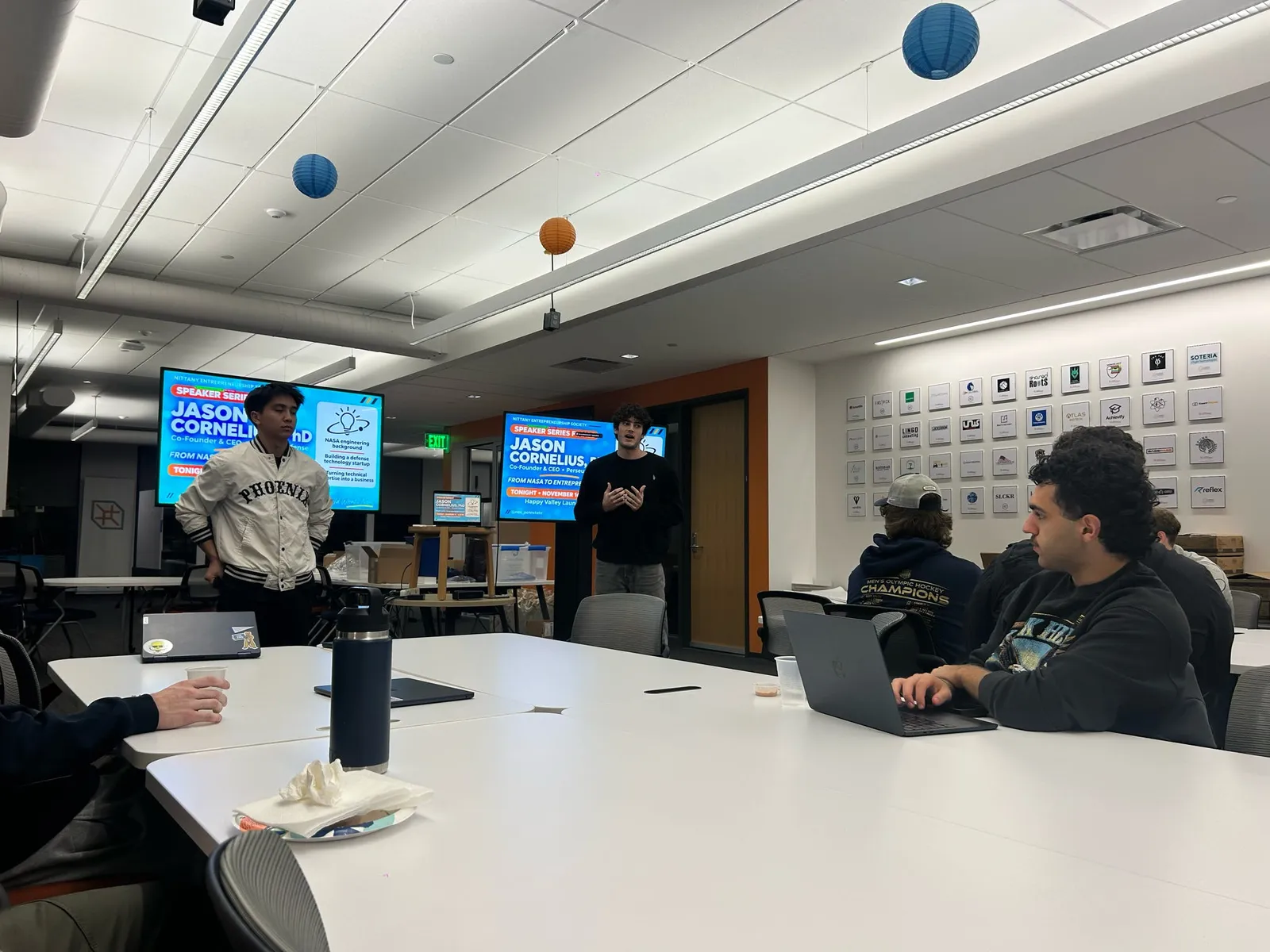
Jason wrapped up a semester of speakers that started with Jason Huber, Mike Xenakis, Todd Erdley and Daniel Haverkos. Like the rest, he left an open door: students thinking about applying to YC can reach out to him, and as Perseus grows, he expects to hire, including someone on the finance side soon.
The thread through the whole talk was persistence. Six applications to NASA. Two to YC. A year and a half of missiles that did not hit anything. In Jason’s words, if you are not willing to keep going until it works, maybe don’t even try. If you are, it could be the wildest adventure of your life.
Want to go deeper?
- Perseus DefenseThe company site, team and test footage
- Y CombinatorPerseus Defense’s YC company page (Summer 2025)
- Interesting EngineeringThe Yuma Proving Ground test, covered
- Defence BlogThe Army’s Golden Shield exercise, where HARPE was tested
THREE THINGS TO DO THIS WEEK.
- Pick one opportunity you gave up on after one rejection, and apply again.
- Talk to five people who would actually use your idea, and write down what they said.
- Build the smallest demo that proves you can move fast, in a week or less.
This is an edited recap of Jason’s talk and the questions that followed, not a verbatim transcript. Figures are as Jason described them in the room. It leaves out club announcements and conversation after the meeting.
Join the next conversation