
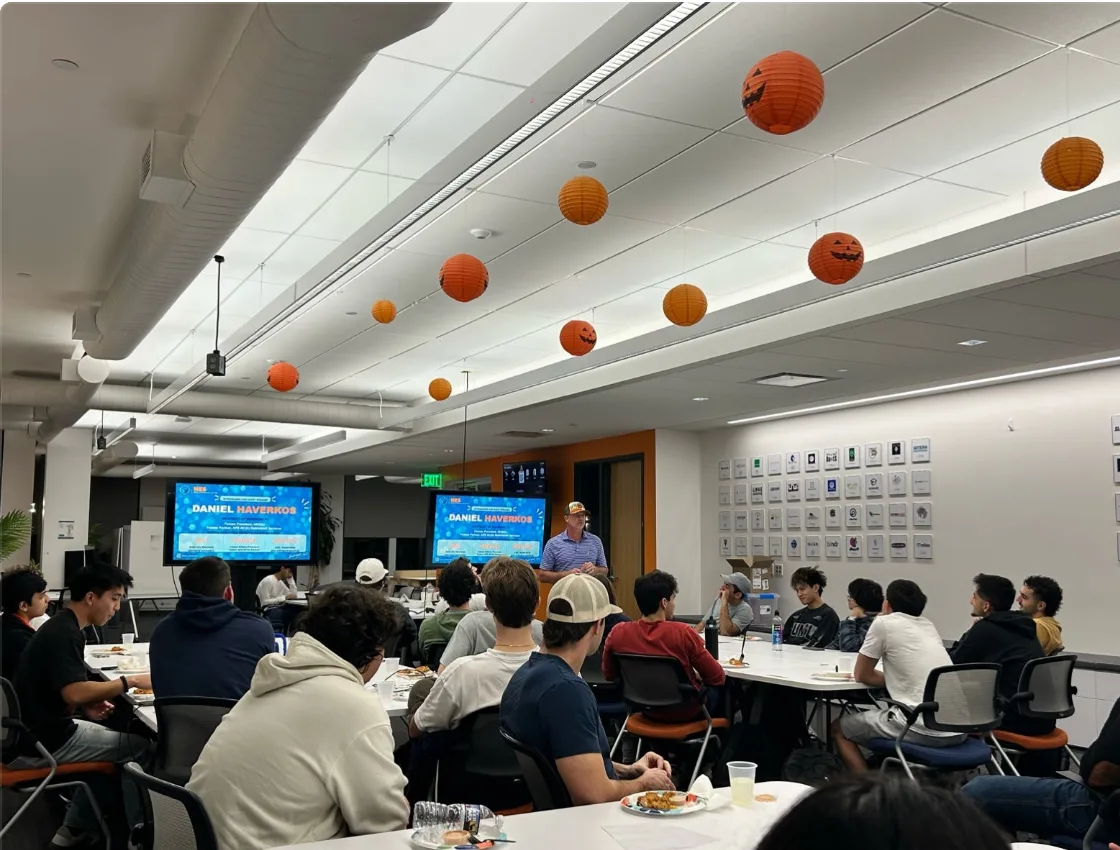
Most people think selling means talking. At this week’s NES meeting, Daniel Haverkos spent the evening proving the opposite. He barely lectured. Instead, he rearranged the room, handed out a blank page, and had members sell each other’s ideas until one lesson stuck: the best salespeople ask more than they tell.
Daniel is a familiar face around Penn State’s startup scene. He first spoke to NES a couple of years ago about real estate, a path he started as a college junior when he bought a house and rented rooms to his soccer teammates. Since then he has run and bought out his own company and now owns a State College house built around a community of student entrepreneurs. He called himself an encourager. This time, he came to talk about sales.
Three words for sales.
He opened with the three words that come to mind when he thinks about selling. The first is consultative: you are there to understand someone’s situation, not to recite a pitch. The second is questions, because curiosity is the main tool. The third is pain, the real problem behind a purchase, which he said has more layers than most founders realize.
Then he put the room to work. About a third of the members were already building something. Daniel had everyone regroup into trios, each with one founder and two members who did not yet have a business. Every person drew a line down a sheet of paper: features and benefits on the left, pain on the right. Founders filled in the left column. The right column stayed blank for now.
Sell someone else’s idea, to them.
Here was the twist. The founder handed their features list to a partner, and that partner had sixty seconds to sell the founder’s own product back to the founder. The third person watched and took notes. Then they swapped, and the observer took a turn selling.
It was awkward on purpose. With no background on the product, the sellers had no choice but to ask questions. The observers noticed what worked. One pointed out that the first job is figuring out who the buyer is, and who it is not. A handyman app looks different to a student whose apartment includes free maintenance. Others named building value through the conversation and personalizing it to the person in front of you. Several observers said their turn felt easier, because they had already watched what the first seller missed.
Pain has levels.
Next, Daniel played the customer and invited founders to pitch him live. A student building an internship search tool asked about his search habits. Another, working on a recovery tracker for athletes coming back from a concussion, asked whether he worried he would never get back to where he was. Each time, Daniel stopped them right as they started describing the product.
He wanted to see how far down they could go. Surface questions are factual and often yes-or-no. That is where most salespeople stay, and they can sell a lot there. A second level asks about the reasons behind the answers. A third level reaches what keeps someone up at night. People sometimes do not know their own pain until a good question helps them see it.
To get there, he suggested something simple: pause. Let an answer sink in. Follow a yes-or-no with “tell me more.” Ask what happens if the problem never gets solved. When one member pitched a language app with a scripted run of yes-or-no questions, the room noticed right away that it felt one-sided and pushed a pain the customer did not actually have.
How deep the questions go
Daniel’s three levels of pain. Most conversations never leave the first one.
- 01Level oneFacts and yes-or-no answersWarm up
- 02Level twoThe reasons behind the answersAsk why
- 03Level threeWhat keeps them up at nightPause and listen
Act like a doctor, not a used-car lot.
Daniel was careful about where this leads. Going deep is not about scaring people or selling off fear. Think of a doctor or a detective: understand where the pain started and why it is there before reaching for the medicine cabinet. Most sellers just list their medicines. Once you reach the real problem, summarize back what you heard, then explain how your product helps.
And if your product cannot solve what you uncovered, he said, have the confidence to say so and point the person to someone who can. Done well, sales is a way of helping. A good salesperson can be a hero to the person across the table.
He also pushed members to use AI every day as a strategic coach, not a shortcut around learning. His habit: after a sales conversation, describe to an AI what happened, how it felt, and what fell flat, then let it come back with questions and feedback. Earlier in his career, he took a formal consultative sales program called Sandler and suggested members look into consultative selling on their own.
A few things we asked Daniel.
Questions and answers are edited for clarity and paraphrased from the meeting.
What if you take someone to that third level and it gets emotional?
Daniel said that can happen, and he has seen it from both sides. At that point the list of features matters less than whether you can actually deliver. Members added that someone who reaches that level is far more likely to buy, which raises the stakes on keeping your promise or referring them elsewhere.
My business is a YouTube channel. Am I even selling anything?
Yes, the room decided. A creator sells attention and has to keep viewers watching. There is no face-to-face conversation, but the metrics show where people lose interest. Daniel’s point was that every idea solves some pain. Some just take more observation to find.
Isn’t “pain” really about wanting good things, like confidence or the right job?
A member building an AI fitness tracker asked this after Daniel kept pushing past answers like “fragmented tracking.” Daniel agreed that the deeper driver is often what people hope for. Pain is broad, he said, and it includes what happens if those hopes do not come true. Do not lose sight of that when you talk to buyers.
Then he sold us his house.
To close, Daniel turned the method on himself. Instead of listing the features of the entrepreneur house he owns, he asked the room about their pain with housing in State College. Members described the yearly scramble to sign a lease before the good places are gone, roommates whose plans change, and the stress of ending up farther from campus or paying more than they want.
Then he asked what pain the house is really solving. Members pointed to community: a place for people who have not found their crowd in a dorm, surrounded by others who push them to be better. Daniel shared the question he asked himself walking across the stage at his own graduation: how many deep relationships had he built, and was it as many as he had hoped? That, he said, is the real pain the house tries to address. Its deeper promise is identity, leaving knowing better who you are, with people around you who help you get there.
It was a fitting last example. He never once described a room, a rent price, or an amenity. He asked questions, listened, and let the room tell him what mattered. That is the whole method in a few minutes.
THREE QUESTIONS TO ASK.
- What pain sits under each feature you are proud of?
- What happens to your customer if that pain never gets solved?
- If your product cannot fix it, who can you point them to?
This is an edited recap of Daniel’s talk and the group exercise, not a verbatim transcript. It leaves out internal club planning and conversation after the meeting.
Join the next conversation